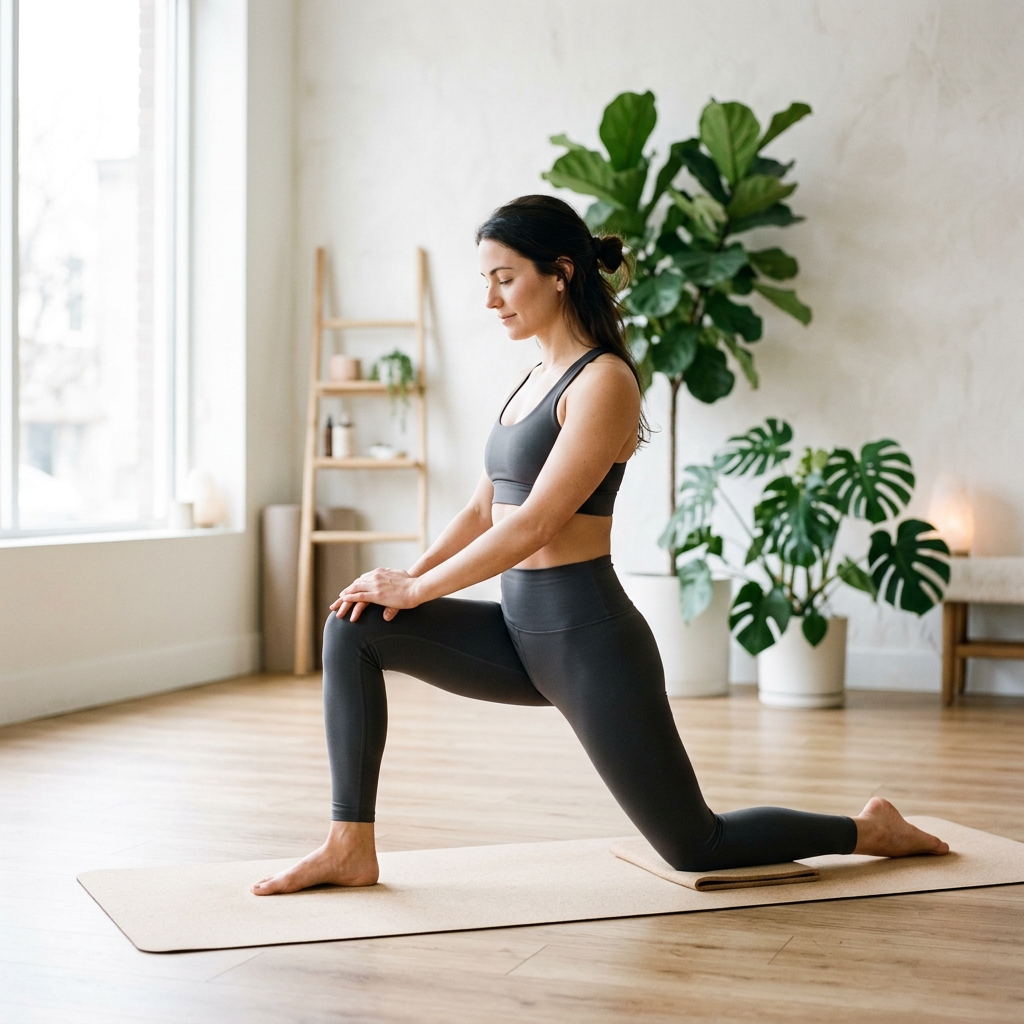
The hip flexor complex — primarily the iliopsoas (psoas major + iliacus) — is designed to bring your thigh towards your torso. When you sit for hours, these muscles stay in a shortened position, gradually losing both their length and their ability to generate force at end range.
The result: anterior pelvic tilt, reduced stride length, increased lower back compression, and a shuffling gait that makes you look (and feel) older than you are.
The Daily Desk Worker Damage
Here's what happens at a cellular level during prolonged sitting:
- Sarcomere number decreases — muscle fibres physically shorten by losing functional units
- Connective tissue stiffens — fascia becomes less pliable and more resistant to lengthening
- Neural activation patterns change — the hip flexors become neurologically dominant, while the glutes become inhibited
This is often called "lower crossed syndrome" — a predictable pattern of tight hip flexors + lower back muscles paired with weak glutes + deep abdominals.
The 4-Part Daily Routine (15 Minutes)
Part 1: The 90/90 Hip Flexor Release (3 min)
Position yourself in a half-kneeling position with your front knee at 90° and back knee on the ground. Posteriorly tilt your pelvis (tuck your tailbone) and lean forward until you feel the stretch in your back hip.
- Hold 30 seconds, 3 sets per side
- Key cue: The stretch should be in the front of the back hip, not the lower back
Part 2: Supine Psoas Release — Dead Bug (4 min)
Lie on your back with arms extended toward the ceiling and knees at 90°. Slowly lower one arm overhead while extending the opposite leg, maintaining lower back contact with the floor.
- 8 reps per side, 2 sets
- This trains the psoas under load through its full range
Part 3: Couch Stretch (4 min)
Kneel facing away from a couch. Place your back shin on the couch seat and bring your front foot to a lunge position. Maintain upright torso.
- 60 seconds per side, 2 sets
- The deepest hip flexor stretch in this sequence
Part 4: Hip Flexor Strengthening — Tall Kneeling March (4 min)
From tall kneeling, brace your core and lift one knee off the ground, bringing it to 90°. Hold 2 seconds, lower slowly.
- 10 reps per side, 2 sets
- This strengthens hip flexors through range, not just passively lengthens them
When to Do This Routine
Ideally daily — morning or post-work are both effective. Research shows hip flexibility training is more effective with daily shorter sessions than longer weekly sessions.
Frequently Asked Questions
Most people see noticeable improvement in 2–4 weeks of consistent daily stretching (10–15 minutes per day). Significant structural changes take 8–12 weeks.
Yes — tight psoas and iliacus muscles pull the pelvis into anterior tilt, increasing lumbar lordosis and compressing the lumbar discs. Addressing hip flexor tightness is one of the first steps in resolving non-specific lower back pain.
Both. Most desk workers have hip flexors that are simultaneously tight (shortened) and weak (not generating force through full range). Stretch first to restore length, then strengthen through that range.